
A TCXO and an OCXO are both quartz reference oscillators; they differ in how they deal with temperature. A TCXO (temperature-compensated crystal oscillator) measures temperature and corrects the frequency electrically, reaching typically ±0.1 to ±2.5 ppm with milliwatts of power. An OCXO (oven-controlled crystal oscillator) holds the crystal at a constant elevated temperature, reaching roughly ±0.5 to ±50 ppb, with lower phase noise and aging, at the cost of watts of heater power.
Every synthesizer, sampling clock and timing system takes its accuracy from a reference oscillator, usually at 10 MHz to about 100 MHz. A PLL multiplies that reference to the RF carrier, so the reference’s frequency error scales with the multiplication and its close-in phase noise rises by 20log(N). Choosing the reference is therefore a system decision. This page compares the simple crystal oscillator (XO), the TCXO, the OCXO and GNSS-disciplined references on stability, aging, phase noise and power, and shows how to work out the ppm figure a design actually needs. It belongs to the RF oscillators section of the RF design reference.
Why quartz drifts with temperature
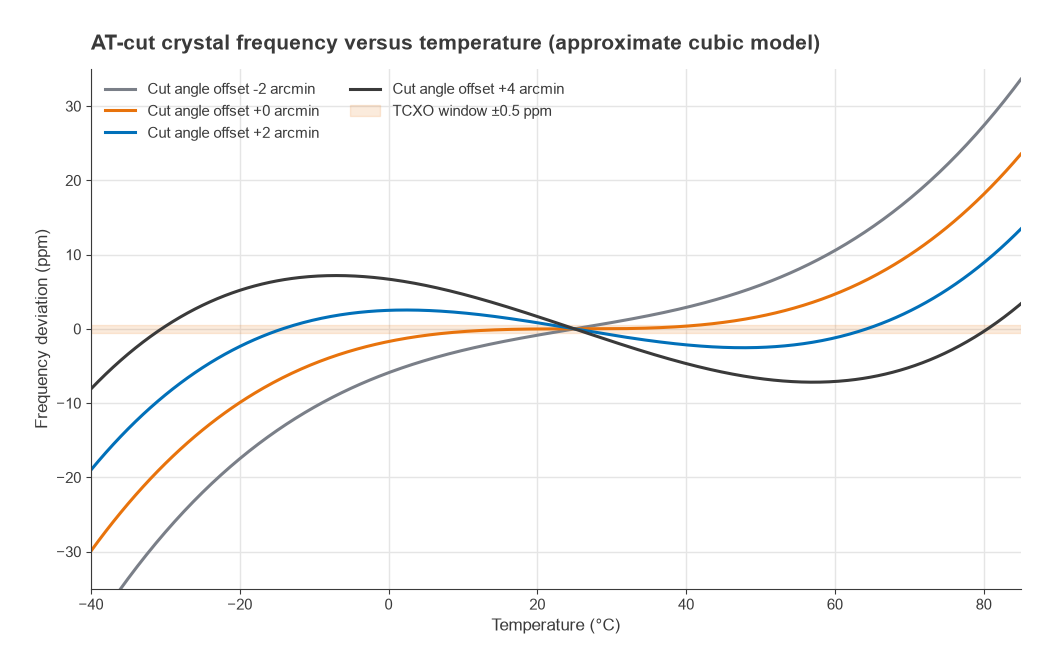
A quartz crystal is a mechanical resonator with an unloaded Q typically in the tens of thousands to the millions, far above any LC tank (see Q factor). Its resonant frequency depends on its dimensions and elastic constants, both of which change with temperature. The angle at which the plate is cut from the quartz bar decides the shape of that dependence. The AT cut, used in most XOs and TCXOs, has a cubic frequency-temperature curve that can be approximated as
Δf/f ≈ a1(Δθ)·(T − T0) + a3·(T − T0)3
with T0 near 25 °C, a3 roughly 1.1 × 10⁻⁴ ppm/K3, and a linear term a1 that depends on the small offset Δθ of the cut angle, roughly −0.08 ppm/K per arcminute. These coefficients are approximate. With these values and no angle offset, the frequency spans −29.9 to +23.5 ppm over −40 to +85 °C. Choosing an offset of about +4 arcminutes tilts the curve so that the total swing over the same range falls to about 15 ppm, or roughly ±7.5 ppm. That is about the best an uncompensated AT-cut crystal can do over the industrial range, and it explains why simple XOs are typically specified at ±10 to ±50 ppm once tolerance and aging are included.
XO, TCXO and OCXO
XO
A plain crystal oscillator relies only on the crystal’s natural curve. It is the cheapest and smallest option and is used where tens of ppm are acceptable: microcontroller clocks, many short-range radios with frequency correction at the receiver, and Ethernet or USB clocks.
TCXO
A TCXO adds a temperature sensor and a compensation circuit that applies a correction voltage to a varactor in the oscillator. Modern TCXOs generate the correction digitally or with an analog polynomial generator that matches the cubic curve. Residual error comes from imperfect curve fitting, thermal gradients between sensor and crystal, and hysteresis. Typical TCXOs are specified between ±0.1 and ±2.5 ppm over temperature, with ±0.5 ppm a common grade. A voltage-controlled version (VCTCXO) lets a system trim the frequency, for example by automatic frequency control in a cellular handset.
OCXO
An OCXO places the crystal and oscillator in a thermally insulated oven held at a temperature above the highest ambient, typically around 70 to 90 °C, close to the crystal’s turnover point where df/dT is near zero. OCXOs usually use the SC (stress-compensated) cut, which has its turnover point at a higher temperature and lower sensitivity to thermal stress and drive level, giving better aging and phase noise.
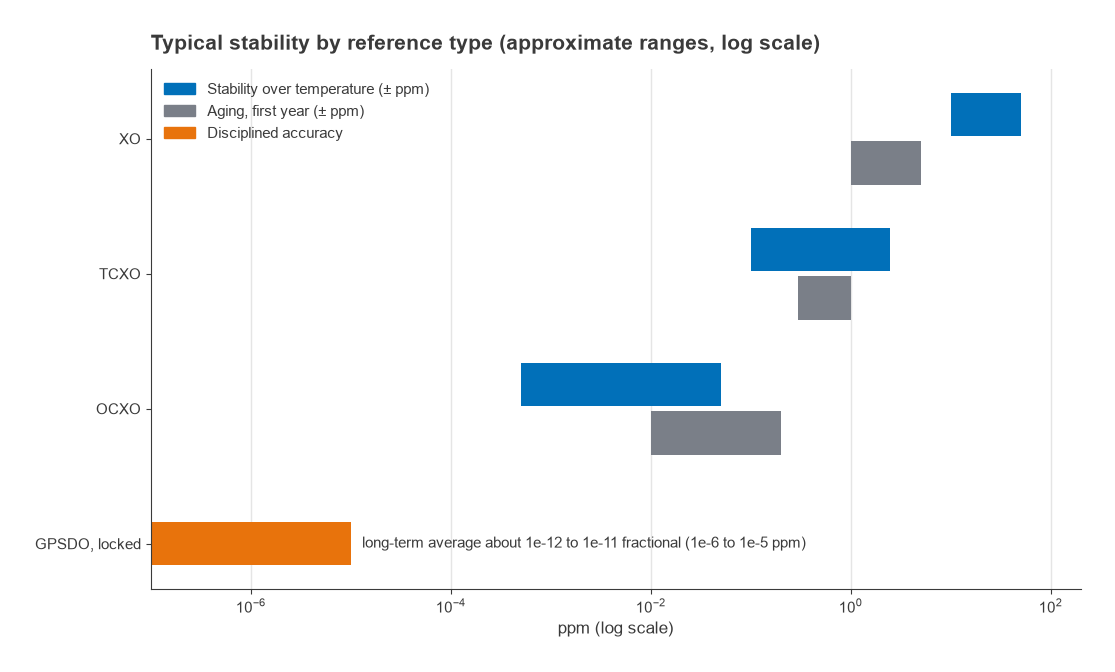
Stability depends on how well the oven rejects ambient changes, expressed as oven gain, and on the crystal’s slope at the set point. As an example, assume the set point is slightly off turnover, so that the crystal slope there is 0.05 ppm/K, and the oven has a gain of 1,000. An ambient change of 125 K moves the crystal by 0.125 K and the frequency by 0.05 × 0.125 = 0.006 ppm, or about 6 ppb. Typical OCXOs are specified at roughly ±0.5 to ±50 ppb over temperature. The oven needs several watts during warm-up, which takes minutes, and usually a few hundred milliwatts to a couple of watts at steady state, depending on size and ambient.
Stability, aging, phase noise and power compared
The values below are typical approximate ranges as of 2026 for 10 to 100 MHz references, based on the general behaviour of each class rather than any single product. Phase noise values refer to 10 MHz.
| Parameter | XO | TCXO | OCXO | GPSDO (locked) |
|---|---|---|---|---|
| Stability over temperature | About ±10 to ±50 ppm | About ±0.1 to ±2.5 ppm | About ±0.5 to ±50 ppb | Set by GNSS, long-term average about 1 × 10⁻¹² to 1 × 10⁻¹¹ |
| Aging, first year | About ±1 to ±5 ppm | About ±0.3 to ±1 ppm | About ±10 to ±200 ppb | Removed while locked |
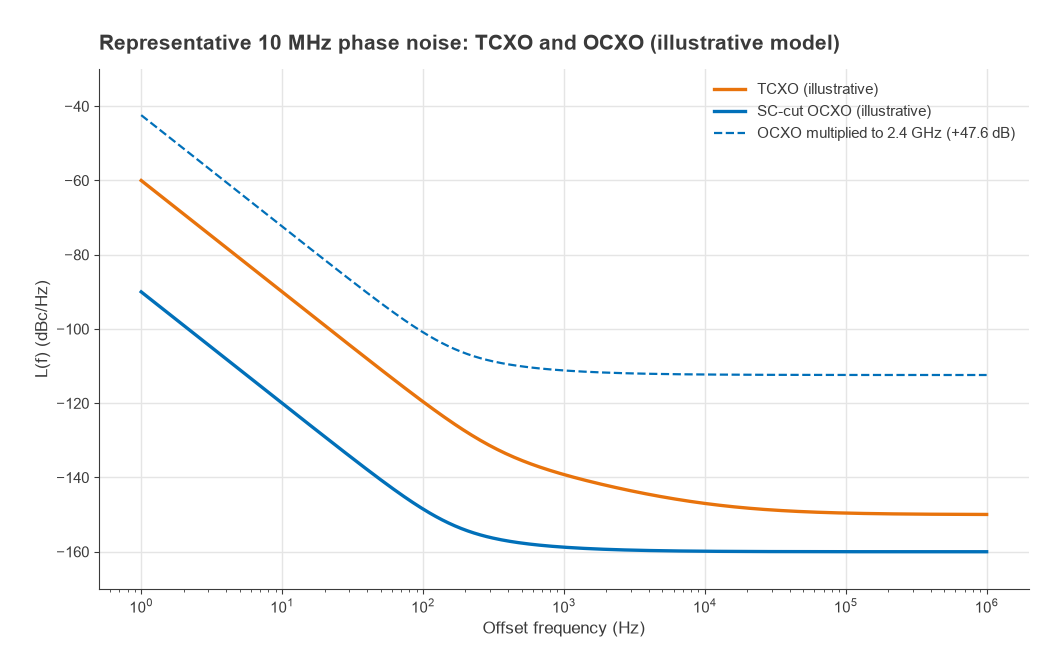
| Phase noise at 1 kHz offset | About −120 to −140 dBc/Hz | About −130 to −145 dBc/Hz | About −145 to −160 dBc/Hz | Set by the disciplined oscillator |
| Power | About 1 to 30 mW | About 2 to 10 mW | About 0.3 to 3 W steady, more during warm-up | OCXO plus GNSS receiver |
| Warm-up | Milliseconds | Milliseconds | Minutes | Minutes to lock |
| Size and cost | Smallest, lowest | Small, low | Larger, higher | Largest, highest |
Phase noise follows the crystal’s high Q and the oscillator’s drive level. The OCXO’s SC-cut crystal and stable thermal environment give it the lowest close-in noise; the TCXO’s compensation varactor and lower drive add noise close to the carrier. When the reference is multiplied by N in a PLL, its noise within the loop bandwidth rises by 20log(N). Multiplying 10 MHz to 2.4 GHz is N = 240, so 47.6 dB is added: a reference at −158.8 dBc/Hz at 1 kHz becomes −111.2 dBc/Hz at 1 kHz from the 2.4 GHz carrier, before any noise from the PLL itself. This is why the reference often dominates close-in synthesizer noise, as described in phase noise and PLL loop filter design.
What ppm stability do you need?
Frequency error at the carrier equals the fractional error of the reference times the carrier frequency:
ΔfRF = (ppm × 10−6) × fRF
The required stability follows from what the receiver can tolerate, and from whether the system can correct errors after the fact.
Worked example: three budgets
- 5.8 GHz point-to-point link with ±20 ppm XOs. Each end can be 5.8 × 109 × 20 × 10−6 = 116 kHz off, so the two ends may differ by up to 232 kHz. That is acceptable if the receiver’s carrier recovery can pull in over ±232 kHz and the channel is several megahertz wide.
- Narrowband 12.5 kHz channel at 450 MHz. Here 1 ppm is 450 Hz. If the allowed carrier error is about ±1 kHz, the reference needs better than about ±2.2 ppm in total, including aging over the service interval, so a TCXO is the realistic minimum.
- Cellular handset. The handset’s transmitted carrier must typically track the received base station carrier to within about ±0.1 ppm. A TCXO of ±0.5 to ±2.5 ppm meets this because the handset measures the base station’s signal and steers its VCTCXO or its synthesizer digitally. The network’s own base stations, which have nothing to lock to, use OCXOs or GNSS discipline.
The general rule is to add up initial tolerance, temperature stability, aging over the product’s life or calibration interval, supply and load pulling, and compare the total with what the link can tolerate or correct. Systems that measure and correct frequency from a received signal can use a cheaper reference than systems that must be accurate on their own.
GPSDO references
A GNSS-disciplined oscillator, often called a GPSDO, steers a local OCXO (or, in lower-cost units, a TCXO) to the timing signals from a GNSS receiver. The receiver produces a one-pulse-per-second output whose individual edges are noisy but whose long-term average is extremely accurate. A slow control loop, typically with a time constant of hundreds to thousands of seconds, compares the oscillator with those pulses and trims it. Inside the loop time constant the output has the oscillator’s low phase noise; over longer times it has the accuracy of the GNSS time scale. The receiver front end itself is described in GNSS front-end design.
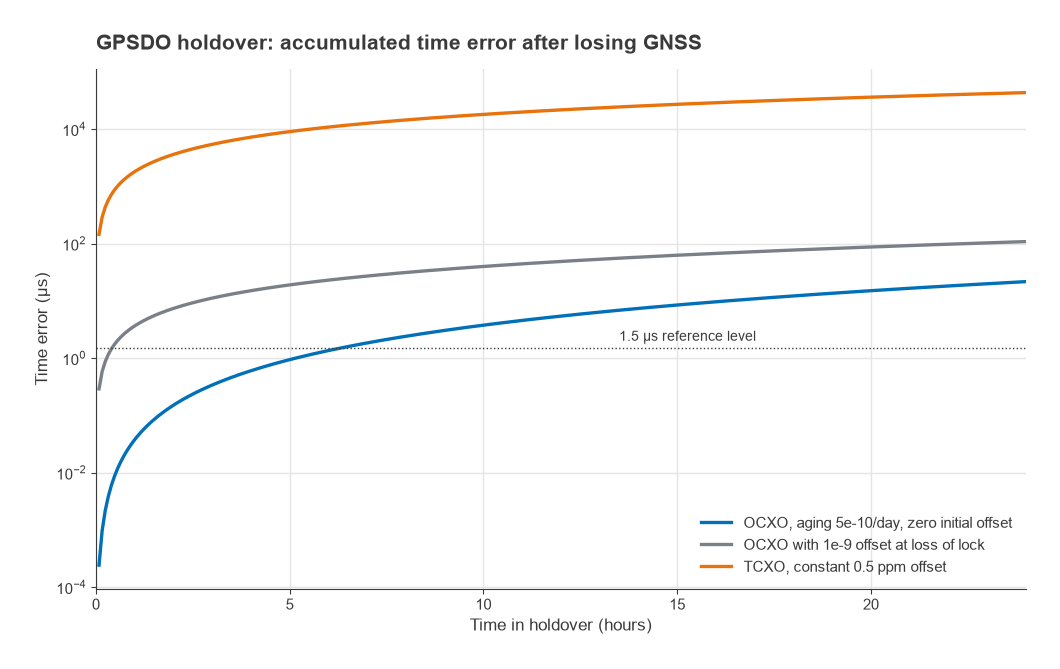
The critical property is holdover: how far the output drifts when GNSS is lost through jamming, antenna faults or indoor installation. With a residual frequency offset y0 and a linear aging rate D, the accumulated time error after time t is
x(t) = y0·t + ½·D·t2
For an OCXO with aging of 5 × 10⁻¹⁰ per day and no initial offset, the time error after 24 hours is ½ × (5 × 10⁻¹⁰/86,400 s) × (86,400 s)2 = 21.6 µs. It passes 1.5 µs after about 6.3 hours. If the same OCXO starts holdover with a 1 × 10⁻⁹ offset, the error reaches 86.4 µs from the offset alone after a day. A TCXO left at a constant 0.5 ppm offset accumulates 43.2 ms per day, two thousand times worse than the aging-only OCXO case. Applications with tight timing, such as synchronized base stations, therefore specify OCXO-based GPSDOs or better, and measure the result as described in phase noise measurement.
Choosing a reference
- Choose an XO when tens of ppm are acceptable or the receiver corrects frequency, and cost, size and power dominate.
- Choose a TCXO for most portable radios, GNSS receivers and narrowband links needing about ±0.5 to ±2.5 ppm with low power and fast start-up.
- Choose an OCXO when the system must be accurate on its own to ppb levels, needs the lowest close-in phase noise for a high multiplication ratio, or needs holdover, and when watts of power and minutes of warm-up are acceptable.
- Add GNSS discipline when long-term accuracy or absolute time is required, choosing the disciplined oscillator for the holdover that the application must survive.
Frequently asked questions
TCXO vs OCXO: what is the difference?
A TCXO corrects the crystal’s temperature drift electrically and reaches about ±0.1 to ±2.5 ppm with a few milliwatts. An OCXO keeps the crystal at a constant temperature in an oven and reaches ppb-level stability with lower phase noise and aging, but uses watts of power, takes minutes to warm up and costs more.
What ppm stability do I need?
Multiply the ppm figure by the carrier frequency to get the frequency error, then compare it with the receiver’s tolerance and channel width. Include initial tolerance, temperature, aging and pulling in the total. If the system can measure and correct frequency from a received signal, a looser reference is usually acceptable.
Why do OCXOs have better phase noise?
They usually use SC-cut crystals with high Q and low sensitivity to drive level, operate at a stable temperature, and avoid the compensation varactor that a TCXO needs. Together these lower the close-in noise, which matters most when the reference is multiplied to a high carrier frequency.
What is holdover in a GPSDO?
Holdover is the period after the GNSS signal is lost, during which the disciplined oscillator runs freely. Its frequency offset and aging cause time error to accumulate, linearly from the offset and quadratically from aging, so the oscillator’s quality decides how long the output stays within specification.
Related topics
The oscillators that a reference disciplines are covered in VCO design, and an alternative frequency source in direct digital synthesis. All oscillator topics are gathered in the RF oscillators hub, and short definitions of terms such as ppm, aging and holdover are in the wireless terms glossary.