

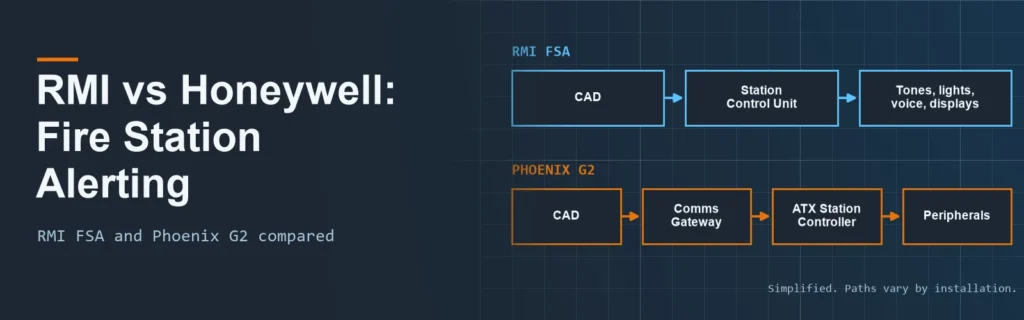
The RMI vs Honeywell decision usually turns on scope. Phoenix G2, from US Digital Designs (USDD) by Honeywell, is a heavily documented alerting platform with a large reported installed base. RMI (RadioMobile) makes its strongest case for agencies that want station alerting, vehicle location and mobile data from one supplier, plus local control of alert sequences, network and radio transport options, and a retrofit that keeps working interfaces. Both offer automated dispatch and zoned alerting, so site-specific proposals should settle the rest.
RadioMobile vs Honeywell: The Name Change Explained
RadioMobile has rebranded as RMI. Readers researching RadioMobile’s fire station alerting technology will therefore encounter both names in product information and customer deployment materials.
The company’s About page says the transition was “not about becoming a different company”. Earlier materials call the product the IQ Fire Station Alerting System, or IQ FSAS. No RMI statement reviewed here formally equates the two names. However, the current RMI FSA page carries IQ FSAS testimonials and the same component descriptions as the 2025 IQ FSAS brochure. This article treats IQ FSAS as the earlier name, on that evidence.
System Overview: RMI FSA and Phoenix G2
Both systems are forms of automated dispatch: they turn computer-aided dispatch (CAD) data into station actions.
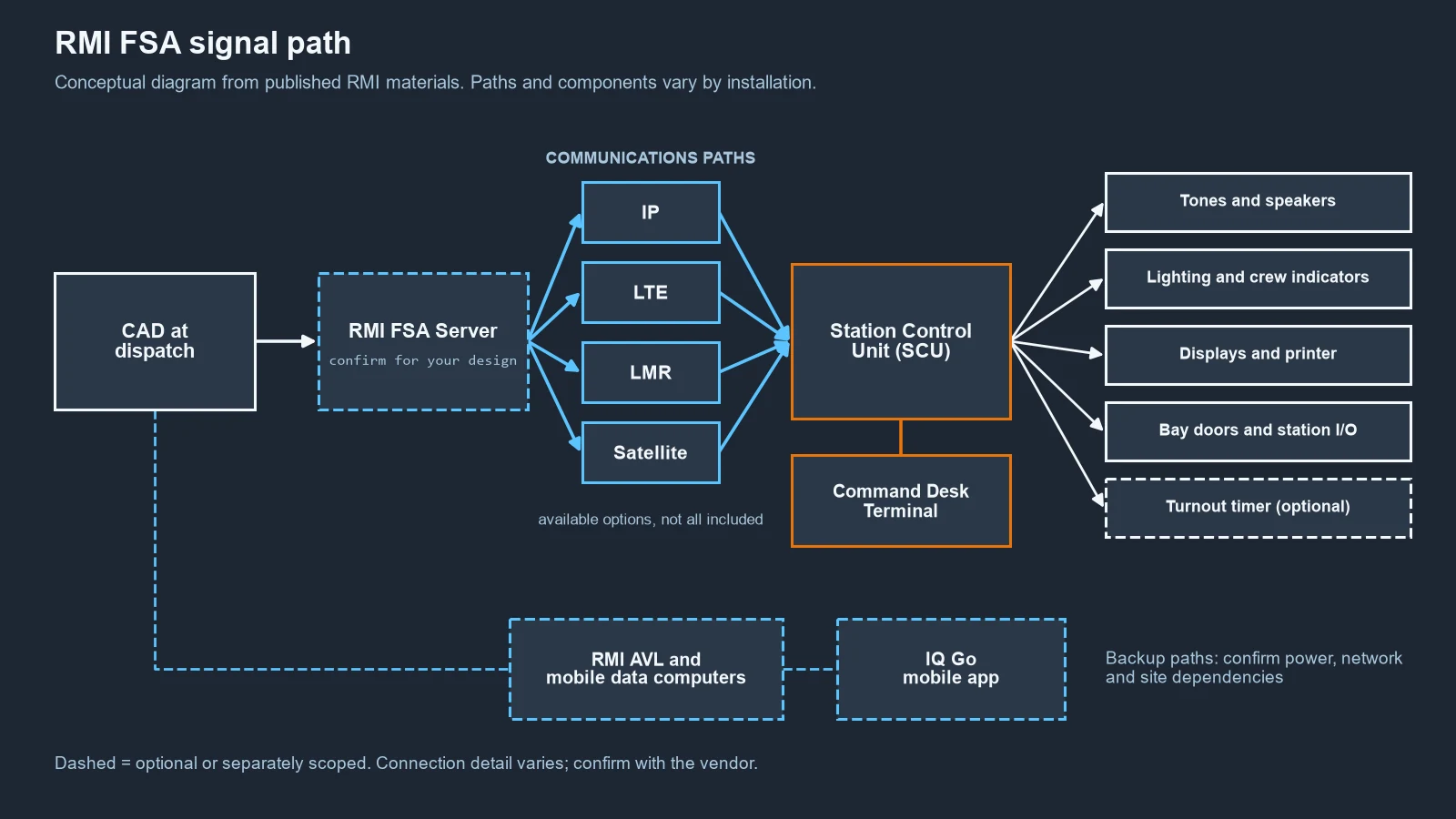
RMI FSA centers on a Station Control Unit (SCU) and a Windows-based Command Desk Terminal (CDT) that runs user-defined sequences. An RMI FSA Server handles CAD data over internet protocol (IP) networks. Crew modules, displays and backup units are offered as options.
Phoenix G2 uses a Communications Gateway at dispatch, an ATX Station Controller at each station, and addressable peripherals. Honeywell says nearly 6,000 fire stations use its systems.
Technical Comparison of Fire Station Alerting Systems
The table covers documented capabilities only and assigns no scores. Abbreviations: LTE is commercial cellular, LMR is land mobile radio, AVL is automatic vehicle location, MDC is mobile data computer, WAN is wide area network, and PoE is power over Ethernet. Where public documents are silent, the entry says to confirm with the vendor.
| Evaluation factor | RMI | Honeywell | Engineering or operational significance |
|---|---|---|---|
| CAD to station | Server relays dispatch and status to CDT and SCU | Gateway alerts one or more stations from a CAD message | Each design adds a dispatch-side component to size, secure and support |
| IP and radio | IP, LTE, LMR, satellite listed | IP WAN, data radio, line modem, or combinations | Options are not automatically included in a given installation |
| Backup | Optional radio-based Backup Command System; manual dispatch | Radio and IP backup, server redundancy, manual alerting | Independence depends on shared power, network and sites |
| Acknowledgment | Positive acknowledgment at dispatch; optional station button | ATX returns acknowledgment to Gateway | Neither document shows that personnel responded |
| Station interfaces | Lighting, speakers, bay doors, printers, timers | Relays, dry inputs, PoE peripherals, signs | Survey existing devices before pricing |
| Administration | Local and remote configuration; Windows CDT | Browser-based, local or remote | Match the model to IT policy and staffing |
| Vehicle location and mobile data | Ties into RMI AVL; RMI MDCs; IQ Go app | FSA Mobile App; AVL integration: confirm with vendor | Decides how many suppliers own the dispatch-to-apparatus chain |
| Installation, maintenance, expansion | Modular additions claimed without full replacement; RMI professional services | Certified installer required in one proposal; low-voltage peripherals | Installer pool and support conditions affect lifetime cost |
| Published cost signals | No public pricing found; confirm with vendor | Agency records and subscription tiers | Public figures do not support a price comparison |
Where RMI Makes a Strong Case
These strengths are documented, but documented does not mean unique. Honeywell equivalents are noted where they exist.
Integration From Dispatch to Responding Apparatus
RMI says RMI FSA ties directly into RMI AVL, its vehicle location product, giving chiefs one view of alerts, unit status and apparatus location. Its AVL page says unit statuses, timestamps and incident information stay synchronized with CAD. In a Los Angeles County Fire case study, RMI reports that apparatus MDCs receive the dispatch alongside the station.
Its IQ Go app adds mobile alerts with incident details and navigation on phones and tablets.
The operational gain is fewer vendor boundaries between the alert and the rig. A battalion chief sees status without reconciling separate systems, and one supplier answers for the chain. Honeywell also offers a mobile app, but its public pages reviewed here show no comparable fleet platform, so ask. Scope AVL and MDCs as separate line items. Best fit: departments replacing station alerting and fleet connectivity together.
Configurable Station Operations
RMI FSA is end-user programmable, with customizable alerts, triggers, tones, voices and sequences. The brochure lists unlimited user-defined sequences. At Pleasant Hill Goshen, RMI reports relays disabling a stove and gas barbecue.
That lets a department encode station practice directly, such as different actions for medical and structure calls. Phoenix G2 offers similar input/output (I/O) rules, so test both on real scenarios. Best fit: departments with varied stations or staffing models.
Communications and CAD Integration
RMI says it interfaces with multiple CAD systems, vendors and dispatch centers. Actual installations differ. Los Angeles County routes alerts over a county LMR network. Pleasant Hill Goshen uses over-the-air two-tone signaling with a path to IP and CAD later. Kern County describes its system as over-the-network.
An agency can therefore start from the network it already has. Satellite and LTE are listed options, so confirm how each would carry alerts at a given site. Best fit: rural or multi-agency systems with uneven connectivity.
Targeted Crew Alerting
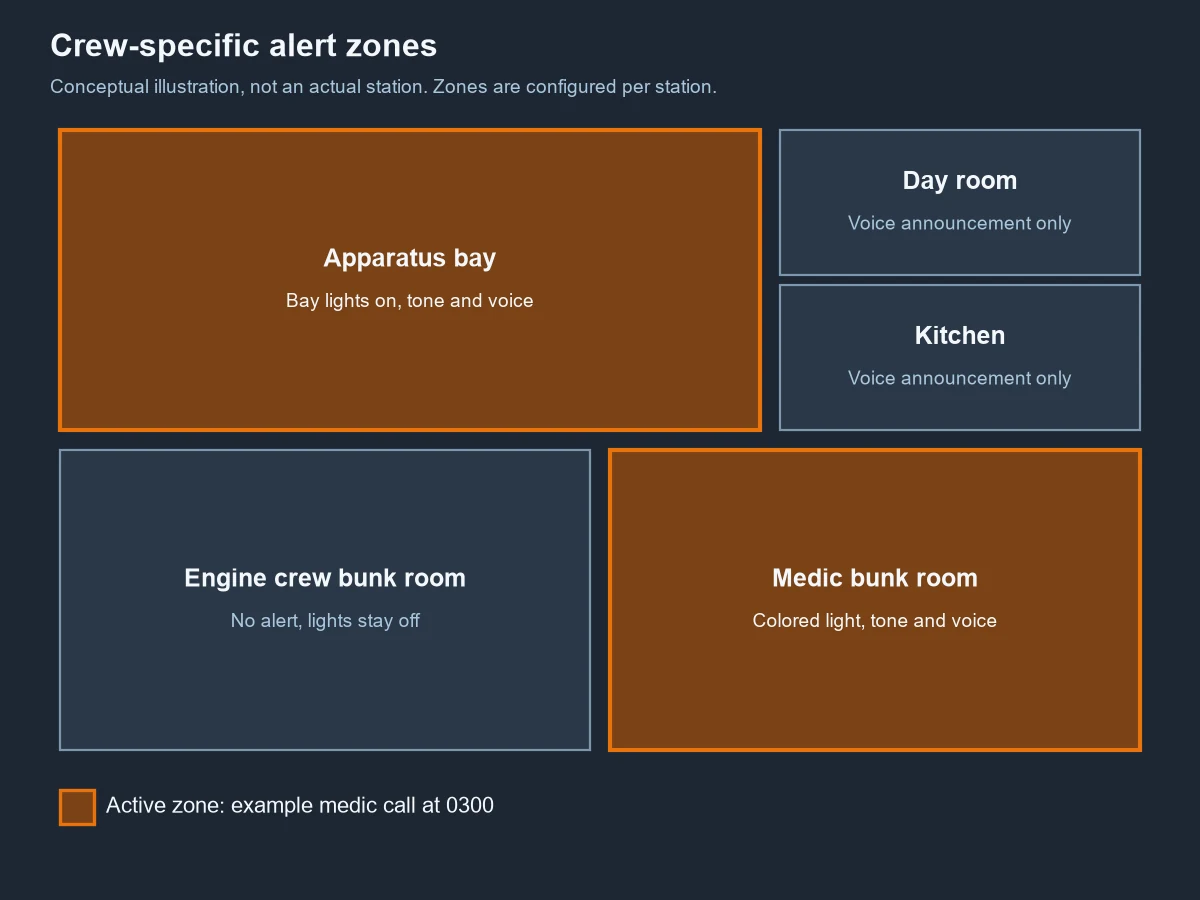
Zone control directs lighting and audio to the crews and spaces a call needs. Colored indicators identify dispatched equipment, and crew-room control sets who occupies each room. In Los Angeles County, RMI reports alerts matched to dorm rooms. A medic call at 0300, for example, can alert the medic room and leave the engine crew’s room dark.
Honeywell documents the same concept, and Howard, Wisconsin assigns bunkrooms by ambulance. Compare room-reassignment workflow, not the feature name. Best fit: staffed stations with several unit types.
Resilience and Monitoring
Each RMI feature addresses a different failure:
- Link loss: multiple data links.
- SCU fault: the optional Backup Command System, a radio-based unit with limited functionality and its own battery.
- CAD outage: manual dispatch, or a Backup Dispatch Alerting Console.
- Power loss: battery backup. RMI’s web page says 24 hours and its 2025 brochure says up to one hour, so get the figure in writing.
- Silent faults and review: health monitoring, time-stamped logs and dispatch acknowledgment.
RMI’s “100% independent” backup wording is a manufacturer description. None of this ensures uninterrupted operation. Honeywell documents comparable layers, including tone decoding when links fail. Best fit: agencies that can map each failure to a tested procedure.
Modernization Using Existing Infrastructure
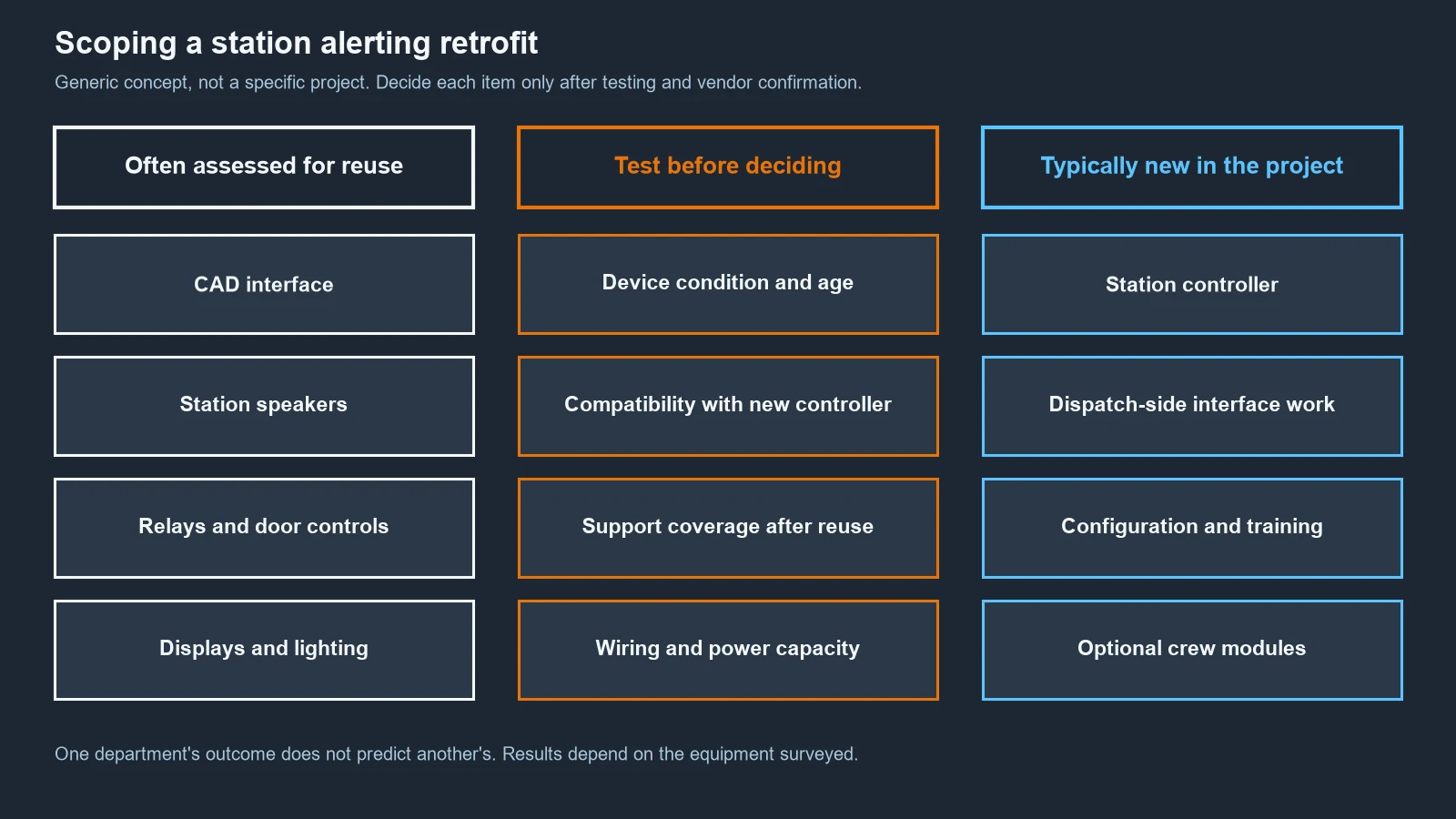
Kern County Fire Department confirms that its Technology Services section maintains the RadioMobile station alerting system. A testimonial on RMI’s product page, attributed to Fire Chief David Witt, says IQ FSAS saved “time and thousands of dollars” by reusing the department’s CAD interface and in-station devices. The agency page does not address reuse or savings, and no amount is stated.
For retrofits, the relevance is the method: audit what still works before scoping replacement. RMI’s brochure also lists codes compatible with an agency’s current alert system. Honeywell makes a similar retention claim. One department’s result does not predict another’s savings. Best fit: departments with serviceable CAD interfaces and station devices.
Where Honeywell Deserves Consideration
Honeywell’s public documentation is a real advantage. It publishes native CAD interfaces, sample requests for proposals and budgeting worksheets, and an installation manual. Peripherals run power, audio and Ethernet over one Category 5 cable. Honeywell reports redundant Gateway servers, a perpetual software structure and military authorization.
Regional fit can matter most. Berkeley staff cited USDD’s use by most Alameda County departments, which could make regional backup dispatching easier. A neighboring-agency check belongs early in any evaluation.
Engineering and Procurement Checklist
Ask both vendors, in writing:
- Which CAD version and interface type are proven, with references?
- Which transport paths are included, and which are options?
- Where do primary and backup paths share power, routers, towers or sites?
- What does acknowledgment confirm, and how are unanswered alerts escalated?
- Which features are standard, optional, or separately purchased?
- Which existing speakers, relays and displays will be reused after testing?
- Who may change configurations, locally and remotely?
- What are the battery runtime and warranty terms for the quoted model?
- Who may install, and do third-party connections affect support?
- What are five-year and ten-year ownership costs, including dispatch-side work?
Frequently Asked Questions
Is RMI the same company as RadioMobile?
Yes, by the company’s own account. Its website says RadioMobile is now RMI, while its footer still shows RadioMobile, Inc. and radiomobile.com remains its site.
Does RMI FSA integrate with my CAD?
RMI says it interfaces directly with most CAD systems, but no named list was found. Honeywell publishes a native interface list. With either vendor, confirm your CAD version and whether two-way status is supported.
Can existing station equipment be reused?
Often in part. Both vendors describe reuse, and Kern County’s testimonial reports it. Test each device for condition, compatibility and support coverage.
What backup communications are available?
RMI documents multiple links, a radio-based backup option and manual dispatch. Honeywell documents radio and IP backup and manual alerting. Treat each as a separate path only after tracing its dependencies.
How should cost be evaluated?
Compare complete scopes. Howard, Wisconsin reported $91,557.50 plus $5,236.24 annually for one Phoenix G2 station, with dispatch-side technology funded separately. That is not a benchmark, and no comparable RMI figure was found.
Conclusion: Choosing Between RMI and Honeywell
Choose RMI for evaluation first if alerting, AVL and mobile data should share one supplier, or if radio-based transport, custom sequences and reuse of working equipment drive the project. Weight Honeywell more heavily if published CAD lists, certified-installer practice, or regional Phoenix G2 interoperability matter most. Readers considering RMI can review RMI’s fire station alerting information and request a demonstration using real station scenarios.