

SNR is the ratio of signal power to noise power measured in a stated bandwidth, while Eb/N0 is the ratio of energy per bit to noise power spectral density, which does not depend on bandwidth at all. The two are linked by Eb/N0 = SNR × B/Rb, where B is the noise bandwidth and Rb the bit rate. RF designers use SNR to set receiver levels and Eb/N0 to compare modulation schemes fairly.
This page sits in the noise in RF systems section. It defines both ratios, shows how to convert between them, and tabulates the SNR each common modulation needs to reach a target bit error rate. That number is the last term in every sensitivity calculation.
Defining SNR and Eb/N0
Signal-to-noise ratio is a power ratio:
SNR = S / N = S / (N0B)
S is the average signal power and N the noise power inside bandwidth B. For white noise, N = N0B, where N0 is the one-sided noise power spectral density in W/Hz. At the input of a receiver with noise figure F, N0 = kT0F, which is the familiar −174 dBm/Hz plus the noise figure in dB. The thermal noise and kTB page derives that floor and the noise figure page explains how F raises it.
The weakness of SNR as a figure of merit is that it depends on which bandwidth is used. Quote the same signal in a 1 MHz bandwidth and in a 2 MHz bandwidth and the SNR differs by 3 dB, although nothing about the link has changed. Eb/N0 removes that ambiguity. The energy in one bit is the signal power multiplied by the bit duration, Eb = S/Rb, so
Eb/N0 = (S/Rb) / N0 = SNR × B / Rb
Both Eb and N0 are energies (joules, or W/Hz), so the ratio is dimensionless and is normally quoted in dB. Because it normalises by the bit rate, it lets a 1 kbit/s BPSK link and a 1 Gbit/s 64-QAM link be placed on the same bit error rate chart.
Es/N0: the symbol-level ratio
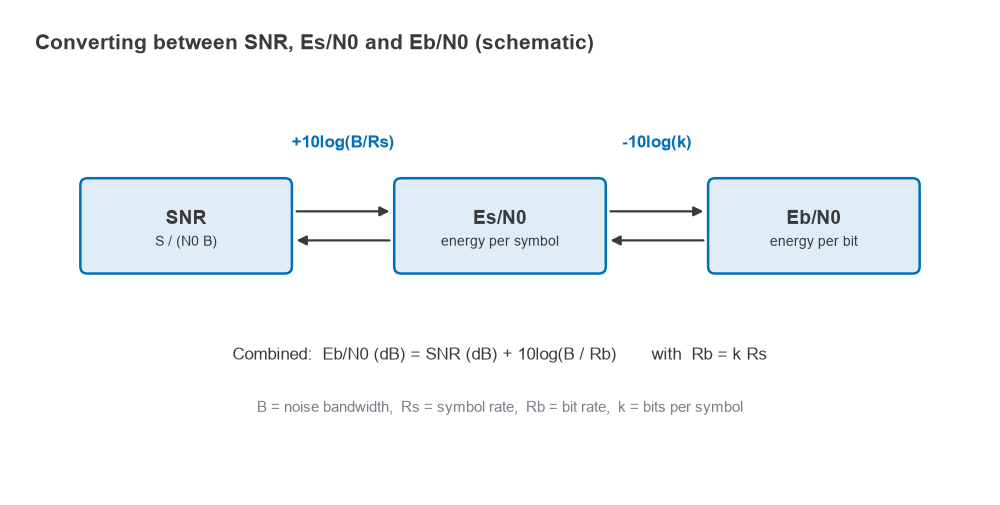
Between the two sits Es/N0, the energy per symbol over N0. A modulation carrying k bits per symbol (k = log2M for an M-point constellation) has Es = kEb and Rb = kRs, where Rs is the symbol rate. In dB:
- Es/N0 = Eb/N0 + 10log(k)
- SNR = Es/N0 − 10log(B/Rs)
- SNR = Eb/N0 + 10log(Rb/B)
A receiver that uses a root-raised-cosine matched filter has a noise bandwidth equal to the symbol rate, whatever the roll-off factor. In that case B = Rs and the SNR at the matched-filter output equals Es/N0. This is the most useful convention for link budgets, and it is the one used for the SNR column in the table below.
Converting between SNR and Eb/N0
The conversion needs three numbers: the bandwidth in which SNR was measured or specified, the symbol rate and the number of bits per symbol. If a forward error correction code is used, Rb should be the information bit rate, not the coded rate, so that the coding gain shows up as a lower required Eb/N0.
Worked example: 16-QAM at 10 Msym/s
A 16-QAM signal runs at Rs = 10 Msym/s, so Rb = 4 × 10 = 40 Mbit/s. The demodulator reports an SNR of 20 dB in a noise bandwidth of 10 MHz.
- B/Rb = 10/40 = 0.25, and 10log(0.25) = −6.02 dB.
- Eb/N0 = 20 − 6.02 = 13.98 dB.
- Uncoded Gray-coded 16-QAM needs about 14.4 dB for a BER of 10−6. At 13.98 dB the theoretical BER is about 2.9 × 10⁻⁶, so this link is roughly 0.4 dB short of the target before any implementation loss is counted.
Had the same SNR been quoted in a 13.5 MHz occupied bandwidth (a roll-off of 0.35), the noise in that bandwidth would be 1.30 dB higher than in 10 MHz. The same signal would then read as an SNR of 18.7 dB, while Eb/N0 stays at 13.98 dB. That is exactly why Eb/N0 is preferred for comparisons, and why any SNR figure on a datasheet or test report should come with its bandwidth.
Bit error rate versus Eb/N0
For coherent detection in additive white Gaussian noise (AWGN), the bit error rate of each modulation follows from the distance between constellation points. The standard results, with Q(x) the Gaussian tail probability, are:
- BPSK and Gray-coded QPSK: Pb = Q(√(2Eb/N0))
- M-PSK (approximate): Pb ≈ (2/k) Q(√(2kEb/N0) sin(π/M))
- Square M-QAM (approximate): Pb ≈ (4/k)(1 − 1/√M) Q(√(3kEb/((M − 1)N0)))
- Non-coherent binary FSK: Pb = ½ exp(−Eb/2N0)
QPSK has the same BER as BPSK for a given Eb/N0 because its two quadrature channels are independent BPSK signals. It carries twice the bits in the same bandwidth, which is why it costs 3 dB more SNR but no more Eb/N0. Denser constellations pack points closer together for a given average power, so each step from 16-QAM to 64-QAM to 256-QAM costs roughly 4 to 5 dB more Eb/N0 at a BER of 10−6.
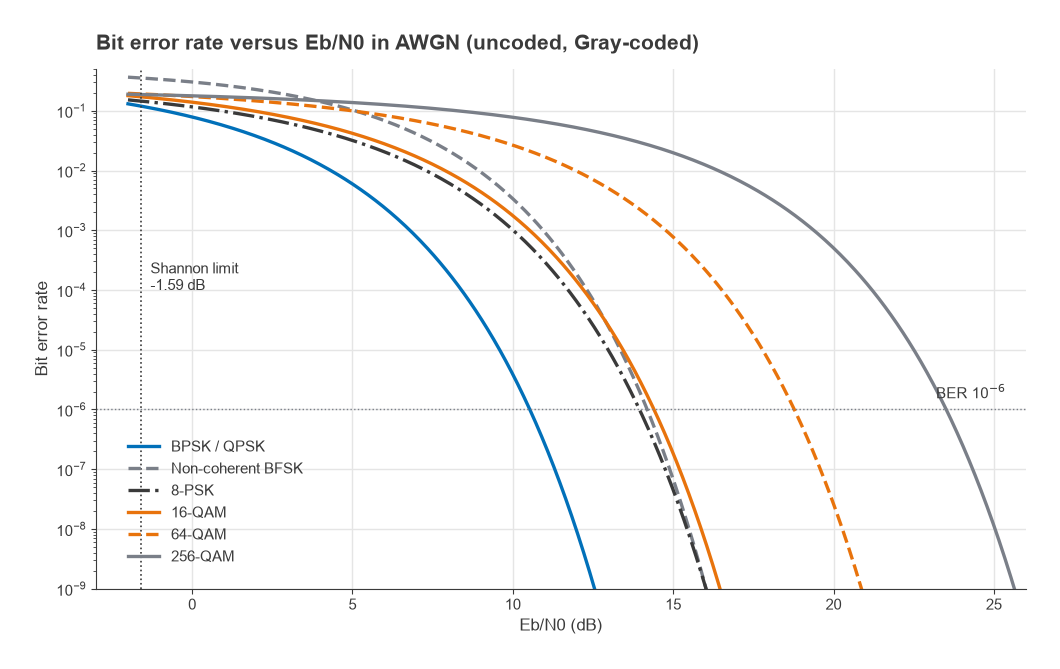
The curves also show the absolute floor. Shannon’s capacity theorem says that no scheme, however well coded, can communicate reliably below Eb/N0 = ln 2, or −1.59 dB. Modern turbo and LDPC codes come within roughly a dB or two of that limit at low spectral efficiency, which is why coded systems can work at Eb/N0 values well below the uncoded numbers in the table.
Required SNR by modulation
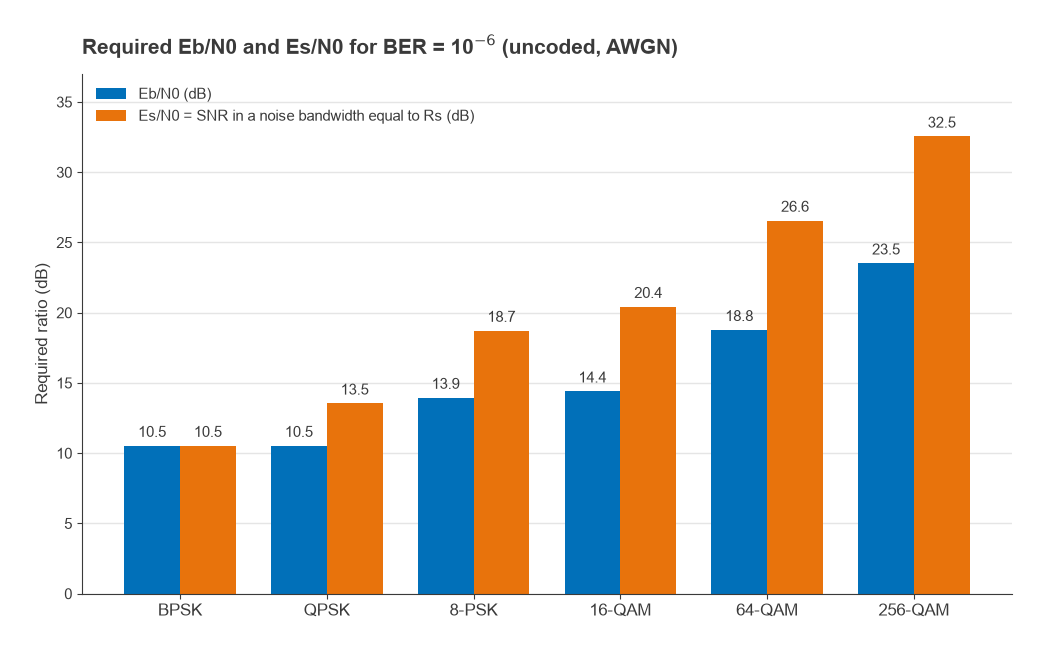
The table gives the theoretical uncoded requirement in AWGN for two common targets, computed from the formulas above. The SNR column assumes a matched-filter noise bandwidth equal to the symbol rate, so it equals Es/N0.
| Modulation | Bits per symbol | Eb/N0 at BER 10−3 (dB) | Eb/N0 at BER 10−6 (dB) | SNR (Es/N0) at BER 10−6 (dB) |
|---|---|---|---|---|
| BPSK | 1 | 6.8 | 10.5 | 10.5 |
| DBPSK (differential) | 1 | 7.9 | 11.2 | 11.2 |
| BFSK, non-coherent | 1 | 10.9 | 14.2 | 14.2 |
| QPSK | 2 | 6.8 | 10.5 | 13.5 |
| 8-PSK | 3 | 10.0 | 14.0 | 18.7 |
| 16-QAM | 4 | 10.5 | 14.4 | 20.4 |
| 64-QAM | 6 | 14.8 | 18.8 | 26.6 |
| 256-QAM | 8 | 19.4 | 23.5 | 32.5 |
These are the starting points, not the final design values. A practical link budget adds several allowances on top:
- Implementation loss. Imperfect carrier and timing recovery, filter mismatch and quantization typically cost from a fraction of a dB to a few dB, more for dense constellations.
- Transmitter and receiver impairments. Phase noise, I/Q imbalance and PA compression all set an EVM floor. An SNR requirement of 32 dB for 256-QAM is meaningless if the transmitter’s own EVM corresponds to an SNR of 30 dB.
- Fading margin. The AWGN curves fall steeply. In a Rayleigh fading channel the BER falls only about tenfold per 10 dB, so the margin needed for mobile links is much larger.
- Coding gain. Forward error correction subtracts from the requirement. The net effect is usually quoted by the standard or modem vendor as a required SNR at a given block error rate, which should replace the uncoded figure when it is available.
From required SNR to receiver sensitivity
Receiver sensitivity is the input level at which the demodulator just reaches its required SNR. Stacking the terms in dB gives the standard expression:
Psens (dBm) = −174 + 10log(B) + NF + SNRreq
Substituting SNRreq = Eb/N0 + 10log(Rb/B) shows that the bandwidth term cancels and Psens = −174 + 10log(Rb) + NF + Eb/N0. Sensitivity depends on the bit rate and the required Eb/N0, not on how wide the filter is, provided the filter is matched to the signal. A wider filter simply lets in noise that the matched filter would have rejected.
Worked example: QPSK sensitivity
A QPSK receiver runs at 1 Msym/s (2 Mbit/s) with a root-raised-cosine matched filter, so B = 1 MHz. Its cascaded noise figure is 5 dB and the target is a BER of 10−6.
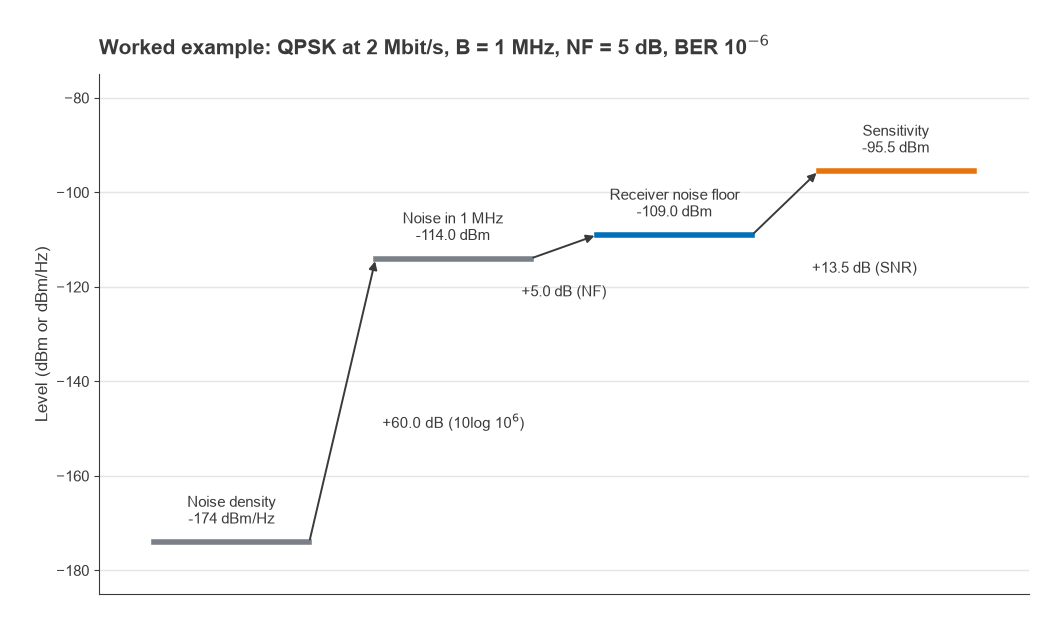
- Required Eb/N0 = 10.53 dB. SNRreq = 10.53 + 10log(2/1) = 13.54 dB.
- Noise in 1 MHz: −174 + 60.0 = −114.0 dBm. Adding NF: receiver noise floor = −109.0 dBm.
- Sensitivity = −109.0 + 13.54 = −95.5 dBm.
- Check with the bit-rate form: −174 + 10log(2 × 10⁶) + 5 + 10.53 = −174 + 63.01 + 5 + 10.53 = −95.5 dBm.
With a 2 dB implementation loss, the figure a designer would actually budget is about −93.5 dBm. The noise figure term is where front-end hardware enters: dropping the NF from 5 dB to 2 dB with a better LNA moves sensitivity by the full 3 dB, as the cascaded noise figure page shows. Radio Architectures Part 4 develops the sensitivity calculation further, and Part 15 places it inside a complete link budget.
Choosing a modulation for a given SNR
The table can be read in reverse. If a link budget shows an available SNR of about 21 dB after margins, uncoded 16-QAM (20.4 dB) is just possible while 64-QAM (26.6 dB) is not. Adaptive modulation schemes in cellular and Wi-Fi systems do exactly this, switching constellation and code rate as the measured SNR changes. The trade-off between power efficiency and spectral efficiency is the central design choice behind the QAM and PSK families, and constellation diagrams make it visible.
Frequently asked questions
What is the difference between SNR and Eb/N0?
SNR is signal power over noise power in a specific bandwidth, so its value changes if the bandwidth changes. Eb/N0 is energy per bit over noise density and is independent of bandwidth. They are related by Eb/N0 = SNR × B/Rb.
What SNR does QPSK need?
Uncoded QPSK in AWGN needs an Eb/N0 of about 10.5 dB for a BER of 10−6, which is an SNR of about 13.5 dB in a noise bandwidth equal to the symbol rate. For a BER of 10−3 the SNR falls to about 9.8 dB. Coding lowers these values and implementation losses raise them.
Is Es/N0 the same as SNR?
Only when SNR is measured in a noise bandwidth equal to the symbol rate, which is the case at the output of an ideal matched filter. If SNR is quoted in a wider bandwidth, such as the occupied bandwidth including roll-off, it reads lower than Es/N0 by 10log(B/Rs).
Why can a coded link work below the uncoded Eb/N0 values?
Error correction adds redundancy that lets the decoder fix many of the errors the demodulator makes. The required Eb/N0, counted per information bit, falls by the coding gain. Strong codes approach the Shannon limit of −1.59 dB but cannot cross it.
Related topics
Required SNR is one input to the wider noise budget described in the noise in RF systems hub, which in turn feeds the RF design guide. Phase noise sets an SNR ceiling of its own for dense constellations, covered on the phase noise page. For quick definitions of the terms used here, see the wireless terms glossary.