

Spurious-free dynamic range (SFDR) is a linearity metric that gives the span between a receiver’s noise floor and the highest input level at which its third-order intermodulation products stay at or below that noise floor. For a two-tone input it equals two-thirds of the difference between the input third-order intercept point (IIP3) and the input-referred noise floor, both in dBm.
Dynamic range describes how wide a range of signal levels a circuit can handle, from the weakest it can detect to the strongest it can tolerate. The lower end is set by noise, the upper end by nonlinearity, and there are several ways to define the upper end. SFDR uses intermodulation; blocking dynamic range uses compression by a single strong signal. This page derives both, works through numbers, and explains how bandwidth, noise figure and IIP3 trade against each other. It belongs to the RF linearity section of the RF design reference.
The lower limit: noise floor
The input-referred noise floor of a receiver over a noise bandwidth B is the thermal noise kTB raised by the receiver’s noise figure:
Nin (dBm) = −174 + 10log10(B) + NF
The −174 dBm/Hz term is kT at a reference temperature of 290 K. Some authors place the lower limit of dynamic range at the noise floor itself. Others use the minimum detectable signal (MDS), which adds the signal-to-noise ratio the demodulator needs: MDS = Nin + SNRmin. The same distinction appears on the receiver sensitivity page. When comparing dynamic range figures from different sources, check which lower limit was used, because the answer can differ by 10 dB or more.
The upper limit: third-order intermodulation
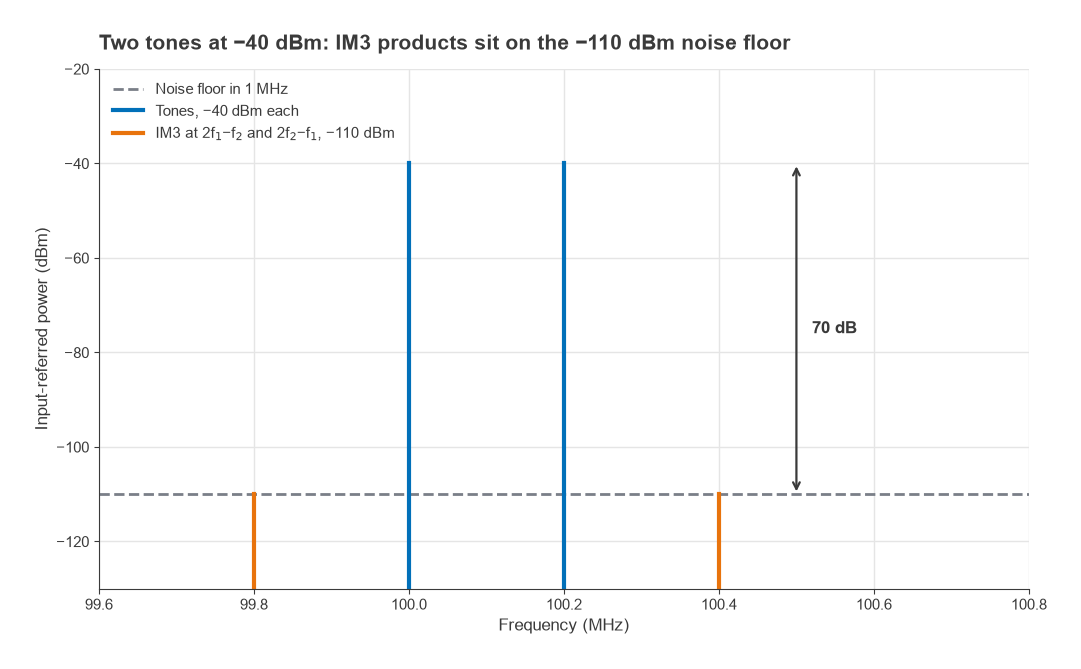
When two equal tones at power Pin (per tone) drive a weakly nonlinear stage, third-order products appear at 2f1 − f2 and 2f2 − f1. Referred to the input, their level follows
PIM3 = 3Pin − 2·IIP3 (all in dBm)
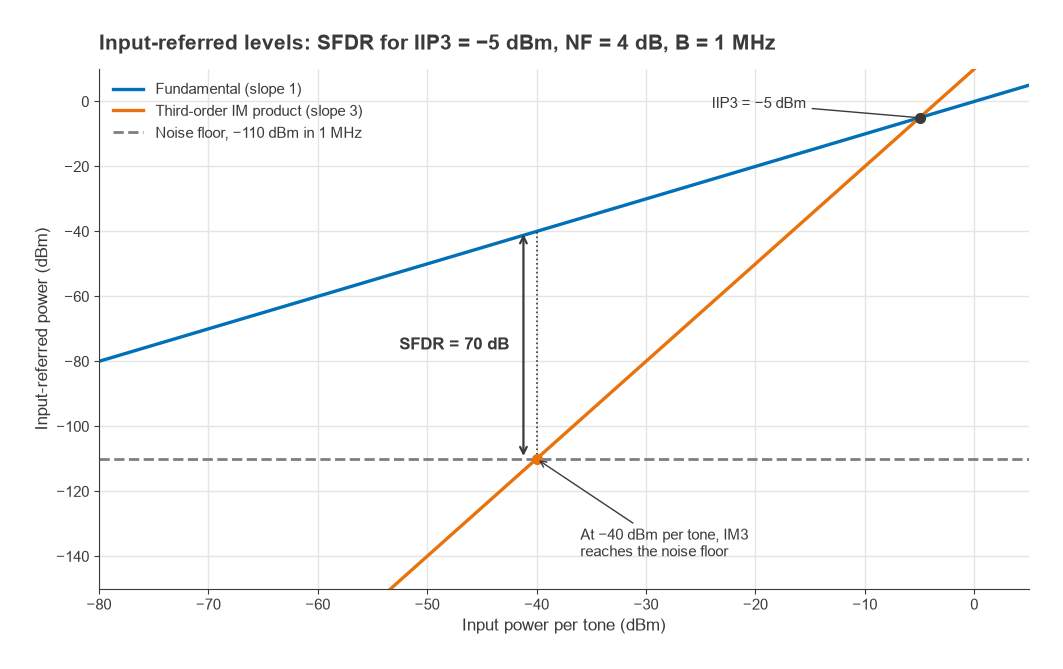
The fundamental rises 1 dB per dB of input while the IM3 product rises 3 dB per dB, and the two extrapolated lines cross at IIP3. The derivation of these slopes is on the intermodulation and intercept point page. Near the noise floor these products are the first spurious signals to appear, because they fall close to the wanted channel and cannot be filtered out ahead of the nonlinearity.
Deriving SFDR = 2/3 (IIP3 − noise floor)
The upper limit of the spurious-free range is the input level at which the IM3 product just equals the noise floor. Setting PIM3 = Nin gives
Pin,max = (2·IIP3 + Nin) / 3
SFDR is the distance from this level down to the noise floor:
SFDR (dB) = Pin,max − Nin = (2/3)(IIP3 − Nin)
Below Pin,max every intermodulation product is buried in noise. Above it, the products emerge as spurs that the demodulator sees as interference. The 2/3 factor comes directly from the 3:1 slope of the IM3 line. The same expression holds when everything is referred to the output, using OIP3 and the output noise floor, since the gain adds equally to both terms.
Worked example
A receiver has NF = 4 dB, a 1 MHz noise bandwidth and IIP3 = −5 dBm.
- Noise floor: Nin = −174 + 60 + 4 = −110 dBm
- SFDR = (2/3)(−5 − (−110)) = (2/3)(105) = 70 dB
- Maximum input per tone: Pin,max = (2(−5) + (−110))/3 = −40 dBm
- Check: PIM3 = 3(−40) − 2(−5) = −110 dBm, equal to the noise floor
Figure 1 plots the fundamental and IM3 lines for this receiver against the noise floor, and Figure 2 shows the corresponding two-tone spectrum. With two −40 dBm tones at the input, the products sit exactly on the floor, 70 dB below the tones. Raise the tones by 10 dB and the products rise by 30 dB, to 20 dB above the floor.
Bandwidth dependence
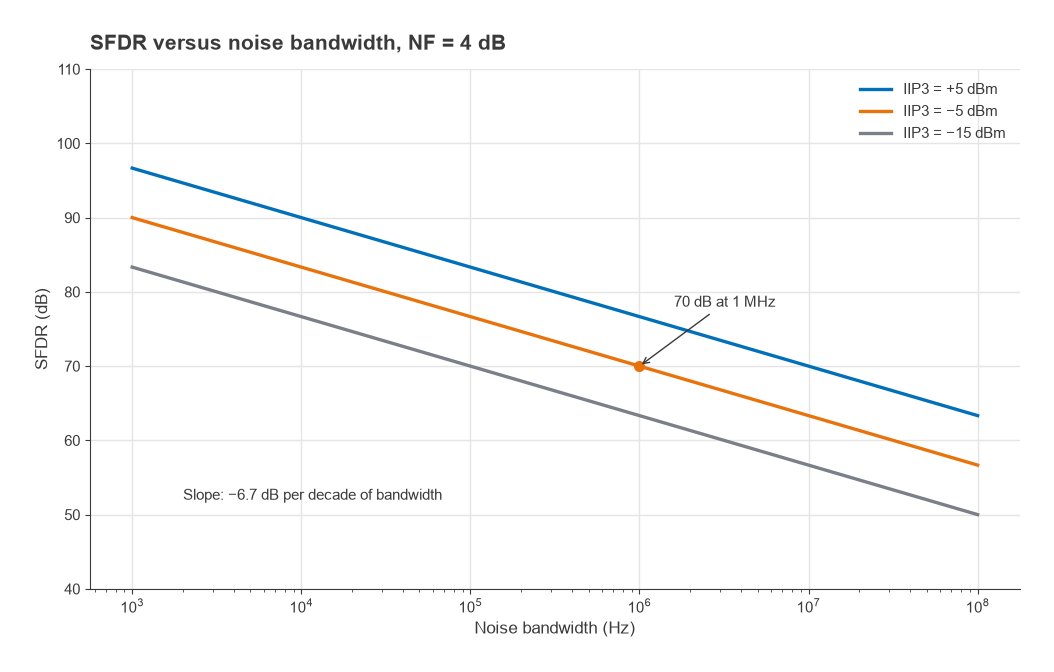
Because the noise floor rises 10 dB per decade of bandwidth and SFDR is 2/3 of the gap to IIP3, SFDR falls by about 6.7 dB per decade of bandwidth. With NF = 4 dB and IIP3 = −5 dBm, the example receiver offers 83.3 dB of SFDR in 10 kHz, 74.7 dB in 200 kHz, 70 dB in 1 MHz, 61.3 dB in 20 MHz and 56.7 dB in 100 MHz. Figure 4 plots this for three values of IIP3. An SFDR figure without its bandwidth is incomplete. Some references, particularly for analog photonic links, normalise to 1 Hz and quote dB·Hz2/3; converting to a real bandwidth then subtracts (2/3)·10log10(B).
Blocking dynamic range
SFDR describes behaviour with two moderate interferers. A single very strong interferer stresses a receiver differently: it compresses the gain seen by the wanted signal. Blocking dynamic range (BDR) is the span from the noise floor (or MDS) up to the level of a single off-channel signal that reduces the gain for a weak wanted signal by 1 dB:
BDR (dB) = Pblock,1dB − Nin
With a pure third-order model, the 1 dB blocking point lies about 12.6 dB below IIP3, and the single-tone input 1 dB compression point about 9.6 dB below IIP3. For the example receiver these are −17.6 dBm and −14.6 dBm, so BDR = −17.6 − (−110) = 92.4 dB and the compression dynamic range (P1dB to noise floor) is 95.4 dB. Measured against a 10 dB SNR MDS of −100 dBm, BDR is 82.4 dB. Figure 3 places all of these levels on one scale.
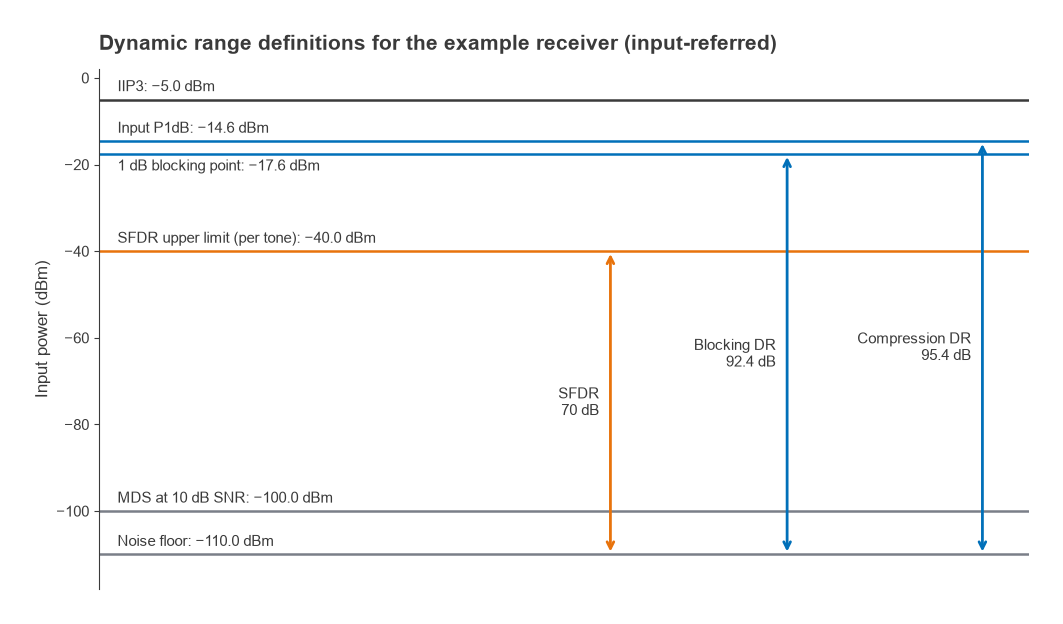
BDR is normally much larger than SFDR, as the example shows: the receiver tolerates one blocker at −17.6 dBm, yet two tones at only −40 dBm already create detectable spurs. Real blocking performance can be worse than the third-order estimate because LO phase noise causes reciprocal mixing well before compression sets in. The blocking and desensitization page covers that mechanism. In receivers that measure BDR, the limit is often whichever of compression or noise rise appears first.
Trading noise figure against IIP3
Since SFDR depends on IIP3 − NF, a lower noise figure helps only if it does not cost more in IIP3. Adding gain ahead of a mixer is the classic case: the cascaded NF improves, but the cascaded IIP3 falls by roughly the added gain, as the cascaded IP3 page shows. Three illustrative lineups, all in 1 MHz:
| Lineup | NF (dB) | IIP3 (dBm) | Noise floor (dBm) | SFDR (dB) |
|---|---|---|---|---|
| Baseline | 4 | −5 | −110 | 70.0 |
| Extra LNA gain | 2 | −12 | −112 | 66.7 |
| No LNA, linear mixer | 6 | +5 | −108 | 75.3 |
The low-noise lineup has the best sensitivity but the worst SFDR. The lineup without an LNA has the widest SFDR but loses 2 dB of sensitivity. Which is better depends on the signal environment. In a crowded band with strong neighbours, SFDR usually matters more; for weak signals in a quiet band, sensitivity wins. Most designs balance the two by putting just enough gain ahead of the mixer to make its noise contribution small.
SFDR of data converters
Data converter datasheets use the same acronym with a different definition. For an ADC or DAC, SFDR is the ratio between a single full-scale tone and the largest spur anywhere in the Nyquist band, usually a harmonic, quoted in dBc or dBFS. It is not referenced to the noise floor and does not follow the 2/3 rule. When an RF lineup feeds an ADC, both numbers matter: the analog SFDR from IIP3 and noise, and the converter’s own spur level. The Radio Architectures Part 20 article discusses how these figures are measured on a complete radio.
Measuring SFDR
A two-tone test applies two equal, closely spaced tones from separate generators combined through a well-isolated combiner. The input level is raised until the IM3 product at the output just becomes visible above the noise floor in the stated bandwidth; the input level at that point minus the input-referred noise floor is the SFDR. Alternatively, measure IIP3 at a higher level where the products are well above noise, measure the noise floor separately, and apply the formula. The second approach is more repeatable but assumes the 3:1 slope holds all the way down. Combiner isolation and the generators’ own intermodulation must be well below the device’s, or the test measures the test setup.
Frequently asked questions
What is SFDR?
Spurious-free dynamic range is the range of input levels over which a receiver or amplifier produces no intermodulation products above its noise floor. For a two-tone input it equals (2/3)(IIP3 − noise floor). A receiver with IIP3 = −5 dBm and a −110 dBm floor has 70 dB of SFDR.
Why is the factor 2/3?
Third-order products rise 3 dB for every 1 dB of input, while the fundamental rises 1 dB. Solving for the input where the IM3 product equals the noise floor places that input two-thirds of the way from the noise floor to IIP3.
What is the difference between SFDR and blocking dynamic range?
SFDR is limited by intermodulation between two interferers and is typically the smaller figure. Blocking dynamic range is limited by a single strong interferer that compresses the gain for the wanted signal, usually by 1 dB. In a third-order model the blocking limit sits about 12.6 dB below IIP3.
Does SFDR depend on bandwidth?
Yes. The noise floor rises with bandwidth, so SFDR falls by about 6.7 dB per decade of bandwidth. Always quote SFDR with the bandwidth it applies to.
Related topics
The linearity metrics behind SFDR are covered in intermodulation and intercept points, P1dB compression and cascaded IP3. The noise side is in noise figure and cascaded noise figure. For system context, see Radio Architectures Part 2: receivers, LOs and mixers and the wireless terms glossary.