

RF design books are the textbooks and references that teach radio-frequency circuit and system design, from matching networks to transceiver architecture. There is no single best one: Bowick’s RF Circuit Design is the best practical introduction, Pozar’s Microwave Engineering is the standard university text, Razavi’s RF Microelectronics leads for RFIC work, and Cripps covers power amplifiers.
This list explains what each of the core books covers, who it suits, and what you should know before opening it. It sits alongside the RF design learning roadmap in the RF careers and learning section, and every topic mentioned here has a matching tutorial within the RF design guide on this site. No rankings by sales or price are implied; the order runs roughly from introductory to specialist.
How to Choose an RF Design Book
RF books differ along two axes. The first is level: some assume only basic circuit theory and teach by worked design, while others assume vector calculus and electromagnetic field theory. The second is scope: some concentrate on circuit blocks such as filters, matching networks and amplifiers, others start from Maxwell’s equations and treat circuits as an application of field theory, and a third group specialises in one area such as integrated circuits or power amplifiers.
Match the book to the work you do. A board-level designer who needs to match an antenna and pick an LNA gets more from a practical circuit text than from a field-theory treatment. A student on a microwave engineering course will be assigned Pozar or something close to it. An engineer joining an RFIC team needs Razavi or Lee, because discrete-component techniques do not transfer directly to on-chip design.
The Core RF Design Books
1. Christopher Bowick, RF Circuit Design
Bowick’s book first appeared in 1982 and was updated in a second edition (2008) with John Blyler and Cheryl Ajluni. It is short, practical and light on mathematics. It covers component behaviour at RF, resonant circuits, LC filter design, impedance matching with L-networks and the Smith chart, small-signal amplifier design from S-parameters, and RF power amplifiers. The design method is shown step by step with numbers, which makes it easy to apply directly to a board.
Who it is for: technicians, hobbyists, digital or analog engineers moving into RF, and students who want an intuitive start before a heavier text. The Radio Architectures series on this site begins from the same ground. Prerequisites: basic AC circuit theory and complex numbers.
2. Reinhold Ludwig and Pavel Bretchko, RF Circuit Design: Theory and Applications
Ludwig and Bretchko (the second edition adds Gene Bogdanov as co-author) bridges practical circuit design and microwave theory. It develops transmission line theory and the Smith chart carefully, then moves through single- and multi-port networks, RF filters, active device models, matching and biasing networks, transistor amplifier design with stability and noise circles, and oscillators and mixers. The treatment is more rigorous than Bowick but stays centred on circuits.
Who it is for: undergraduate students and engineers who want the theory behind the design steps without a full electromagnetics course. Prerequisites: circuit analysis, basic semiconductor devices and some calculus.
3. David M. Pozar, Microwave Engineering
Pozar is the most widely assigned microwave engineering textbook, and the fourth edition is the one most readers will find. It starts with electromagnetic theory and transmission lines, then covers waveguides, microwave network analysis and S-parameters, impedance matching and tuning, resonators, power dividers and couplers, filters, ferrite devices, noise and nonlinear distortion, active devices, amplifier and oscillator design, and an introduction to microwave systems. Its problem sets are a standard source of practice.
Who it is for: university students and practising microwave engineers who want one reference that covers passive and active design with full derivations. Prerequisites: vector calculus and an undergraduate electromagnetics course. Readers without that background can still use the network, matching and amplifier chapters. Pozar’s shorter Microwave and RF Design of Wireless Systems takes a more system-oriented view.
4. Behzad Razavi, RF Microelectronics
Razavi’s book, in its second edition, is the standard text for RF integrated circuit design. It begins with the system concepts that drive circuit specifications, including nonlinearity, noise, sensitivity and dynamic range, then covers modulation, transceiver architectures, LNAs, mixers, oscillators, PLLs and power amplifiers, mostly in CMOS. The architecture chapters are useful even to board-level designers, because they explain why heterodyne, direct-conversion and low-IF receivers behave as they do.
Who it is for: graduate students and engineers working on RFIC design or transceiver architecture. Prerequisites: analog IC design at the level of a first graduate course, and comfort with transistor small-signal models.
5. Steve C. Cripps, RF Power Amplifiers for Wireless Communications
Cripps (second edition, 2006) is the reference most power amplifier designers keep close. It explains the load-line approach that bears his name, the conduction-angle classes from A to C, switching and harmonically tuned modes, efficiency enhancement and the basics of linearization, with an emphasis on physical insight rather than simulation. His companion book Advanced Techniques in RF Power Amplifier Design goes further into Doherty, envelope and other techniques.
Who it is for: engineers designing or characterising PAs, especially those doing load-pull work. Pair it with the power amplifier classes page. Prerequisites: transistor amplifier basics and impedance matching.
Where the five books sit
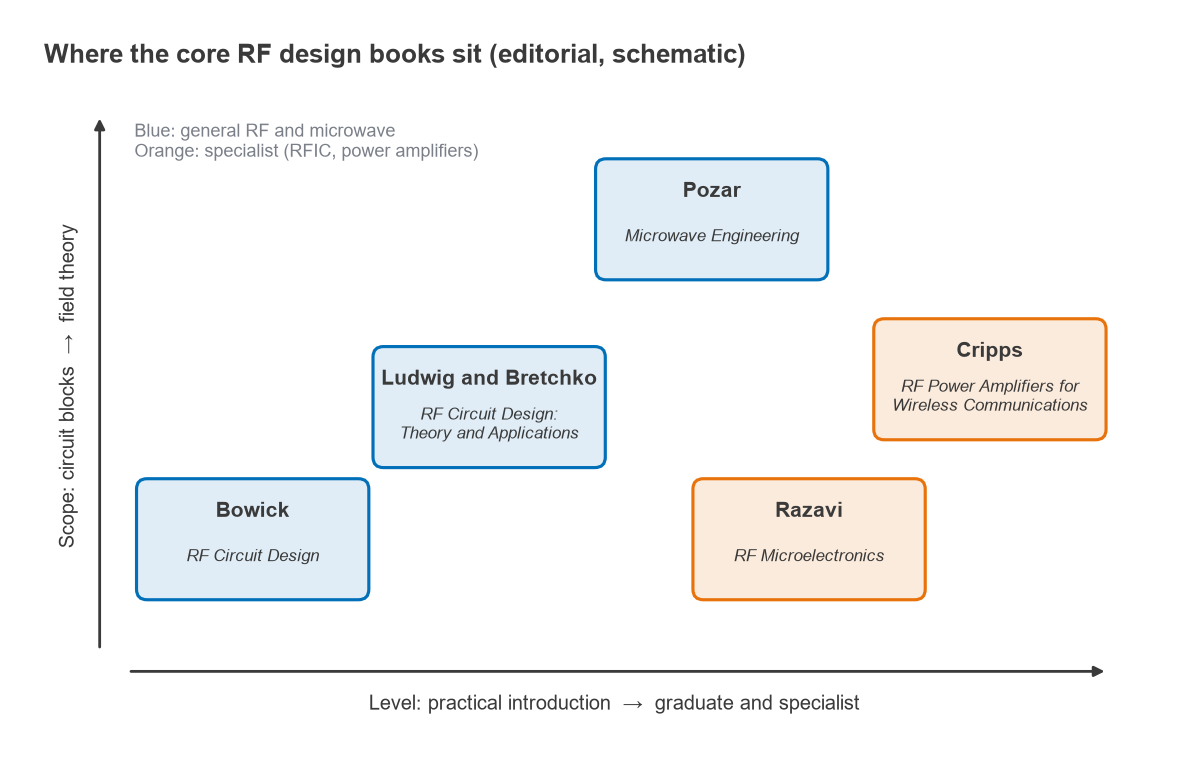
Laid out by level and scope, the books form a rough progression. Bowick and Ludwig and Bretchko are circuit-centred and accessible, Pozar adds field theory and breadth, and Razavi and Cripps go deep into one specialism each.
Quick Comparison
| Book | Level | Focus | Best for |
|---|---|---|---|
| Bowick, RF Circuit Design | Introductory | Components, filters, matching, amplifiers | A practical first book |
| Ludwig and Bretchko, RF Circuit Design: Theory and Applications | Undergraduate | Lines, Smith chart, networks, amplifiers, oscillators | Theory behind circuit design |
| Pozar, Microwave Engineering | Undergraduate to graduate | Field theory through passive and active microwave design | A complete microwave reference |
| Razavi, RF Microelectronics | Graduate | CMOS transceiver architecture and circuits | RFIC and architecture work |
| Cripps, RF Power Amplifiers for Wireless Communications | Specialist | PA classes, load lines, efficiency | Power amplifier design |
Other Books Worth Knowing
- Guillermo Gonzalez, Microwave Transistor Amplifiers: Analysis and Design: a focused treatment of S-parameter amplifier design, stability, gain circles and noise circles.
- Thomas H. Lee, The Design of CMOS Radio-Frequency Integrated Circuits: a companion to Razavi with strong coverage of passives, noise and oscillators on chip.
- William F. Egan, Practical RF System Design: cascaded gain, noise and intermodulation analysis at system level.
- The ARRL Handbook: a long-running practical reference for amateur radio circuits, antennas and construction.
Suggested Reading Order
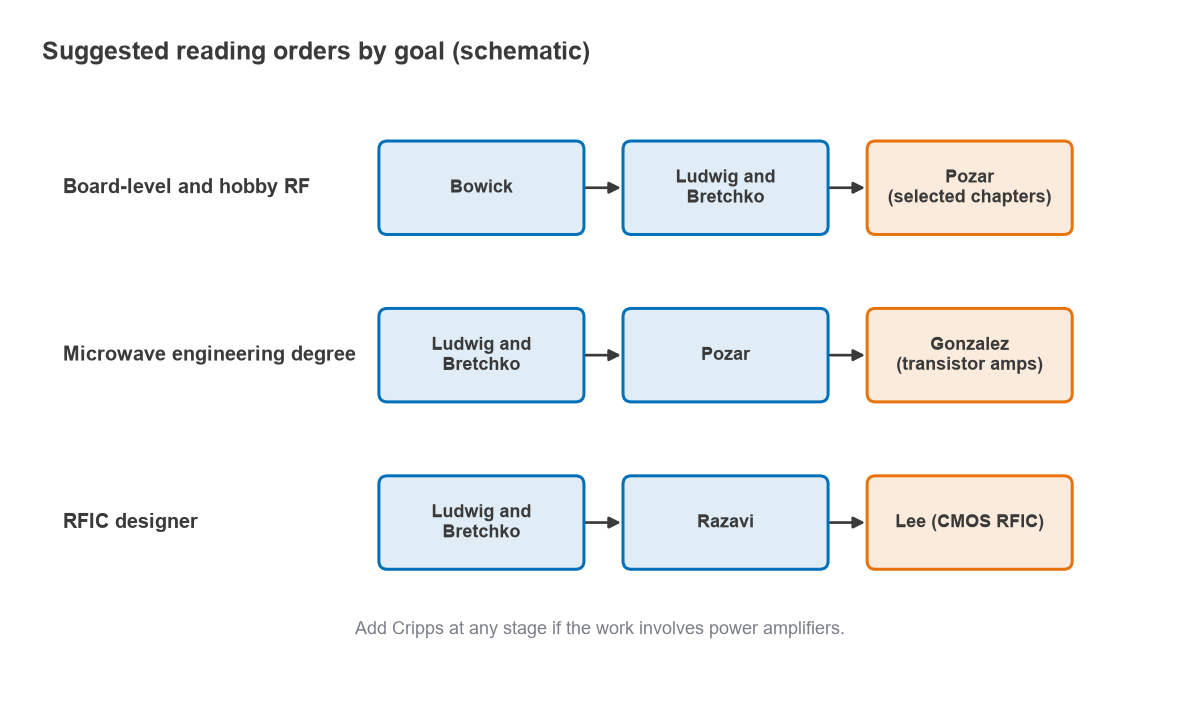
Few people read any of these books cover to cover. A better approach is to read in an order that fits the goal and use the later books as references. For board-level work, start with Bowick, move to Ludwig and Bretchko for the theory, then dip into selected Pozar chapters. A microwave engineering student will usually follow Ludwig and Bretchko or a similar text with Pozar, then Gonzalez for transistor amplifiers. An aspiring RFIC designer should go from a circuit-level RF text to Razavi and then Lee. Anyone working on power amplifiers should add Cripps at whatever stage that work begins.
A Taste of the Material: an L-Network Match
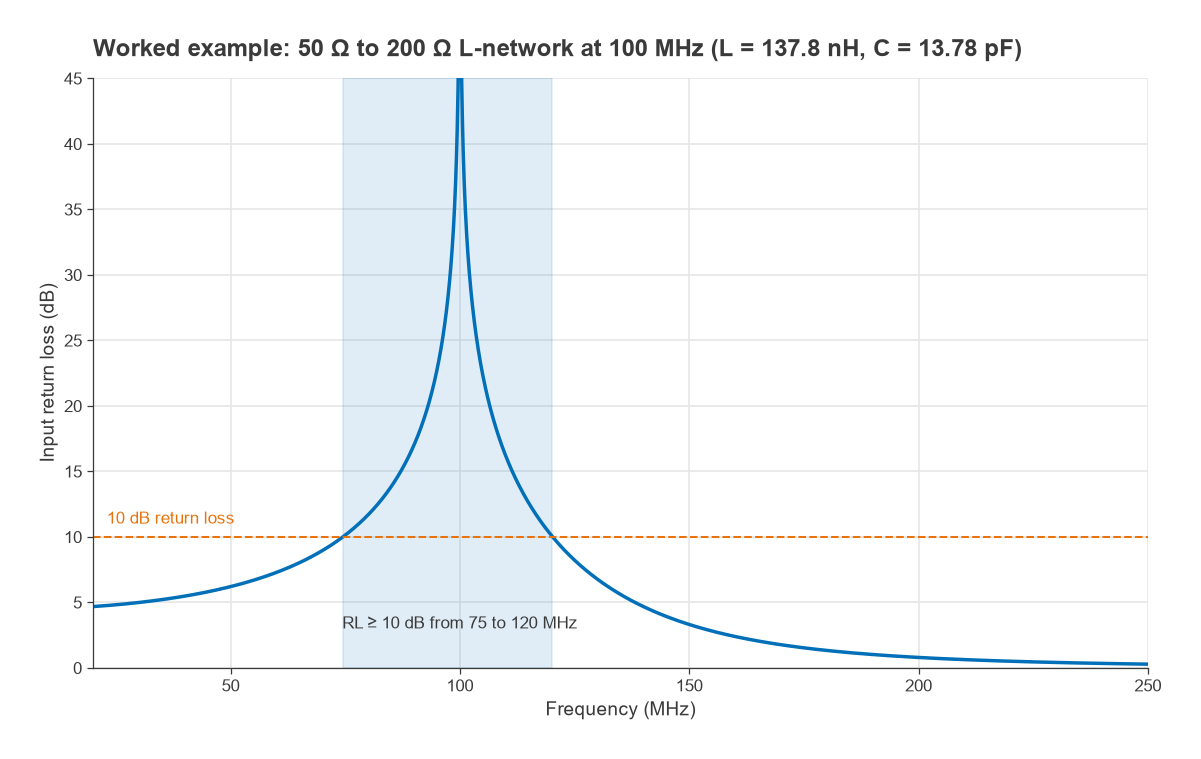
The introductory books all teach the two-element L-network early, because it combines resonance, Q and reactance in one small problem. The method is the same in each. To match a 50 Ω source to a 200 Ω load at 100 MHz with a series inductor and a shunt capacitor across the load:
- Network Q: Q = √(RL/RS − 1) = √(200/50 − 1) = 1.732.
- Series reactance: XS = Q·RS = 86.60 Ω, so L = XS/(2πf) = 137.8 nH.
- Shunt reactance: XP = RL/Q = 115.47 Ω, so C = 1/(2πf·XP) = 13.78 pF.
Computing the input impedance across frequency confirms an exact 50 Ω match at 100 MHz. Return loss stays better than 10 dB from about 75 MHz to 120 MHz and better than 20 dB from about 93 MHz to 107 MHz. The fixed Q of a single L-section is what limits that bandwidth, which is why the books go on to multi-section and Pi or T networks. The L-network matching page works through more cases, and the impedance matching calculator checks results like these.
Frequently Asked Questions
What is the best RF design book?
For a practical start, Bowick’s RF Circuit Design. For a complete university-level reference, Pozar’s Microwave Engineering. For integrated circuits, Razavi’s RF Microelectronics, and for power amplifiers, Cripps. Most working engineers own at least two of these.
Is Pozar good for beginners?
Pozar is clear but assumes electromagnetics and vector calculus. Beginners usually do better starting with Bowick or Ludwig and Bretchko and moving to Pozar once transmission lines and the Smith chart feel familiar.
Which book should I read for RFIC design?
Razavi’s RF Microelectronics is the usual starting point, with Lee’s The Design of CMOS Radio-Frequency Integrated Circuits as a companion. Both assume analog IC design background.
Do I need a book if I use online tutorials?
Tutorials are good for single topics, but a textbook gives a consistent notation and a sequence of worked problems. Using both works well: a tutorial for a quick explanation, and a book for depth and practice.
Related Topics
Follow the RF design learning roadmap for an ordered study plan, test yourself with RF engineer interview questions, keep the wireless terms glossary nearby, and review the Smith chart guide before tackling the matching chapters in any of these books.